
Email marketing for small businesses: launch a useful, profitable first campaign
A practical plan for your small business's first email campaign: goals, contacts, content, frequency, budget, and the metrics that matter.
When you run a small business, email marketing can easily fall behind customers, quotes, and everyday operations. Yet a simple campaign can maintain relationships, generate appointments, and bring former customers back without requiring you to post on social media every day.
The common mistake is to start with the design or the software. A profitable campaign starts with a different question: what specific action do you want a specific group of contacts to take? Here is a realistic method for launching your first campaign without a marketing team.
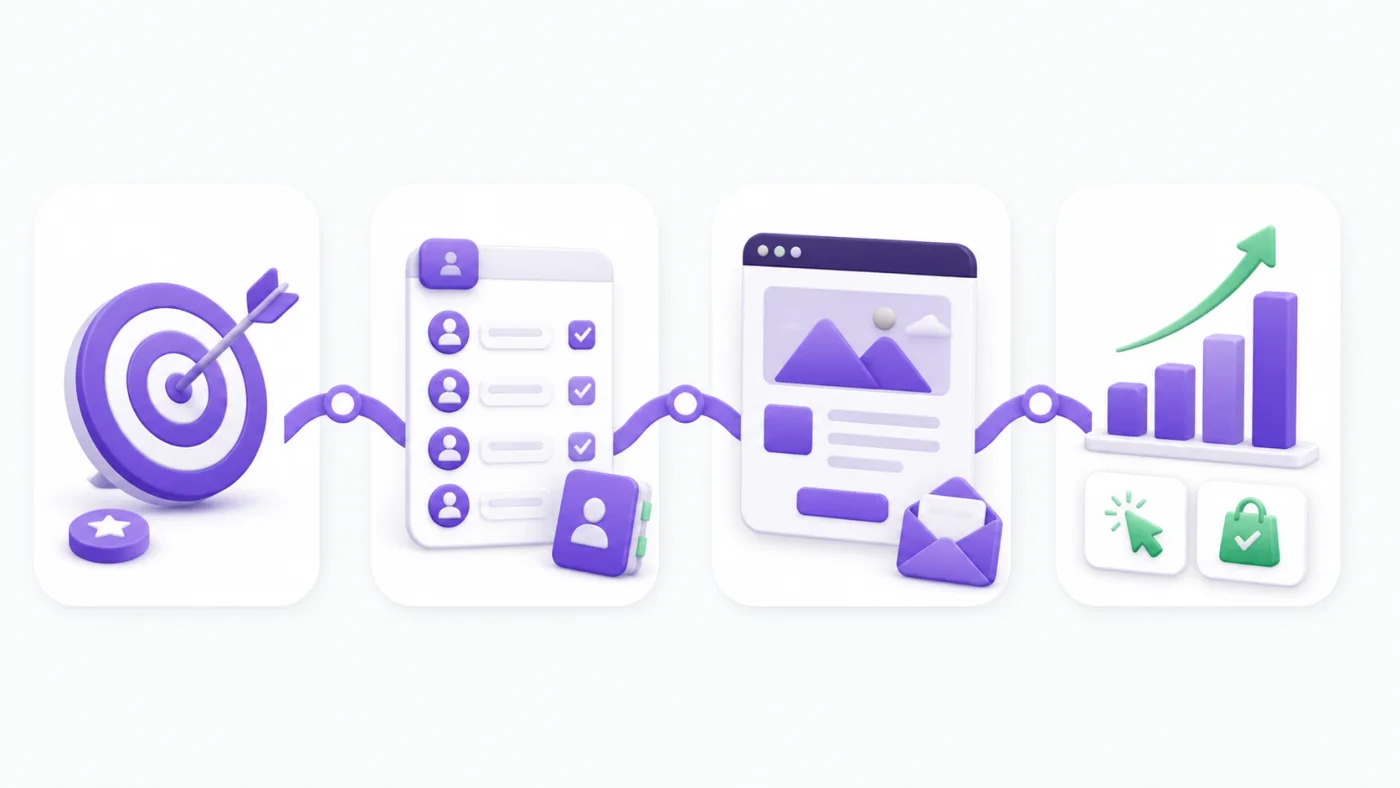
A simple campaign connects a clear goal, the right contacts, a useful message, and measurable results.
Why email marketing works for small businesses
On social media, your visibility depends on an algorithm. With an email list built legally, you can reach people who already know your business directly, including customers, prospects, event attendees, and newsletter subscribers.
A small business can use email to:
- bring customers back after a purchase or service;
- announce a new offer, availability, or event;
- share useful advice that demonstrates your expertise;
- follow up with prospects who requested information;
- stay visible without contacting every person individually.
A small, qualified list is more valuable than a large database of people who do not know you. Relevance and trust matter more than the number of addresses.
1. Choose one commercial goal
Avoid an email that combines a promotion, three company updates, a new service, and four articles. Readers will not know what to do. For your first campaign, choose one measurable goal and one main action.
- Retailer: showcase a selection and lead readers to a product page.
- Service business: generate a quote request or appointment.
- Restaurant: announce a menu, event, or open reservations.
- Consultant: share a useful method and invite readers to talk.
- Tradesperson: show a recent project and invite estimate requests.
Complete this sentence: “After reading this email, I want this group of contacts to take this action.” If the sentence remains vague, the campaign will be vague too.
2. Build a useful, compliant list
Do not buy email lists. You risk contacting people who have no interest in your offer, generating complaints, and damaging your sender reputation. Use contacts gathered through a genuine relationship and retain information about where they came from.
The exact rules depend on where your business and recipients are located. In the European Union, direct email marketing is governed by privacy and electronic communications rules. France's CNIL explains that consumer marketing generally requires prior consent, with a limited exception for similar products or services offered to existing customers. B2B messages must relate to the recipient's professional role, and every recipient must have a simple way to object. Review the CNIL guidance on email marketing and check the rules that apply to your market.
Before importing contacts, keep at least:
- the email address and, when possible, the first name;
- the source and collection date;
- the consent or other legal basis used;
- a useful category, such as customer, prospect, activity, or interest.
3. Segment without making it complicated
Two or three groups are enough to start. You could separate active customers, former customers, and prospects. Their relationship with you is different, so the message and call to action should not be identical.
For example, offer a complementary product to customers, a reason to return to former customers, and reassuring proof to prospects.
4. Write an email people understand in seconds
The subject line
Be specific and credible. “September appointments are now open” or “Three mistakes slowing down your website” provides more context than “Big news!” Avoid exaggerated promises, excessive capitalization, and false urgency.
The opening
Explain immediately why you are writing and what the reader will gain. Do not begin with a long company history.
The body
Use short paragraphs, simple language, and enough white space. Add concrete evidence, such as an example, photograph, observed result, clear condition, or answer to a common objection.
The call to action
Choose one primary button, such as “Book an appointment,” “Explore the offer,” “Request a quote,” or “Read the guide.” Its destination must match the button's promise exactly.
A simple structure to reuse
Subject: a specific promise or useful piece of information
Opening: why this email matters to the reader
Value: advice, an offer, or information explained clearly
Action: one primary button and a simple way to contact you
5. Prepare the send and protect deliverability
Send from a professional address on your domain rather than a free mailbox. Configure SPF, DKIM, and DMARC to help mailbox providers verify that Sendora is authorized to send for your business. Our SPF, DKIM, and DMARC guide explains their role without the jargon.
Before clicking send:
- review the subject line, sender name, and preview text;
- test every link and the primary button;
- check the email on a phone;
- send tests to several mailbox providers;
- keep the unsubscribe link visible and working.
6. Choose a frequency you can maintain
There is no perfect frequency for every small business. A retailer with weekly arrivals has different needs from a consulting firm. Start with one useful email per month. Move to two if you genuinely have something valuable to share and the results remain healthy.
Consistency creates a routine. Sending three emails in one week and then disappearing for six months can tire contacts and make your results difficult to interpret.
7. Measure what actually leads to a customer
Open rate can provide a trend, but privacy protections in some email clients have made it less precise. Do not evaluate it alone. Focus on:
- clicks, which show whether the offer and button create interest;
- replies, which are especially valuable for service businesses;
- conversions, including quotes, bookings, orders, or appointments;
- unsubscribes and complaints, which may reveal poor targeting or excessive frequency;
- delivery errors, which help you remove invalid addresses.
Record the goal, audience, message, and outcome of every campaign. After several sends, you will know which topics and offers genuinely interest your contacts.
A realistic four-week plan
- Week 1: choose one goal and gather the contacts you are allowed to email.
- Week 2: clean the list, create two segments, and authenticate your domain.
- Week 3: write a short email, add one button, and complete your tests.
- Week 4: send it, measure clicks and enquiries, then note one improvement for the next campaign.
Your choice of platform then depends on sending volume, contact count and the features you need. To compare the options, read our comparison of five email marketing platforms for small organizations.
You do not need a complex strategy to begin. A clear offer, a legitimate list, a useful message, and one commercial measurement are enough to learn. Sendora lets you import contacts, create emails, and track results in one interface.
Start small. A well-targeted campaign sent to 100 relevant contacts will teach you more than a generic message sent to thousands of strangers.
Send your emails with Sendora
Domain verification, newsletters, statistics: everything you need to communicate well by email.
Get started now