
How to clean an email list and reduce your bounce rate
Clean your email list, remove invalid addresses, and reduce bounces with a practical seven-step process that protects deliverability.
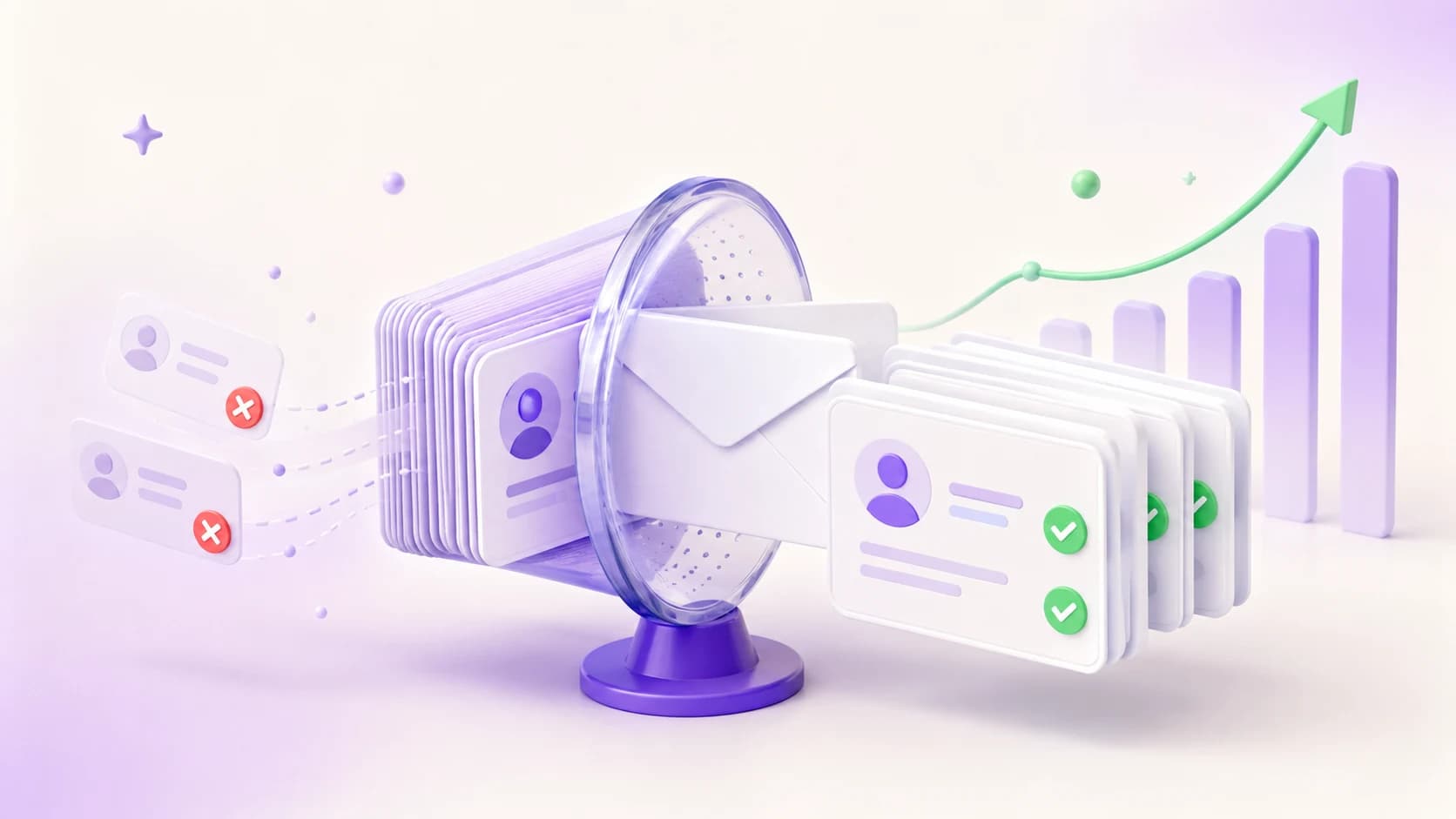
Email lists naturally decay. People change jobs, inboxes disappear, typos enter forms, and subscribers lose interest. Sending to every stored address without maintenance creates bounces and can damage your sender reputation.
Cleaning an email list does not mean deleting every quiet subscriber. The goal is to separate permanently invalid addresses from temporary failures and less-engaged people. This practical process helps you improve list quality without discarding useful contacts.
A simple rule: suppress permanently invalid addresses and complaints immediately, always respect unsubscribes, and quarantine uncertain addresses before making a final decision.
Why email list hygiene matters
Every campaign sends signals to mailbox providers. Nonexistent addresses generate rejections, while recipients who do not recognize you may report the email as spam. Over time, those signals can make it harder to reach even your best subscribers.
- reduce hard bounces and wasted sends;
- protect your domain and sender reputation;
- make campaign analytics reflect your real audience;
- avoid using quota on unreachable addresses;
- maintain a compliant and usable contact database.
Google advises senders to monitor bounces, deferrals, and spam reports, and to reduce volume when those signals rise. Its email sender guidelines also emphasize authentication and gradual volume increases.
Hard bounce versus soft bounce
Hard bounce
A permanent failure caused by an invalid address, invalid domain, or permanently unavailable mailbox. Suppress the address from future sends.
Soft bounce
A temporary failure such as a full mailbox, unavailable server, or temporary rejection. Watch for repeated failures before suppressing the contact.
The distinction matters. Removing an address after one temporary incident can cost you a valid contact, while retrying a permanently invalid address indefinitely harms list quality. Amazon SES documentation likewise defines hard bounces as permanent and soft bounces as temporary.

Which contacts should you remove, quarantine, or keep?
How to clean an email list in seven steps
1. Back up the database and document its sources
Export a backup before deleting anything. Record where each group came from: signup form, customers, event, old platform, or manual import. An address with no clear source deserves more caution than a recently confirmed subscriber.
2. Remove duplicate records
Normalize addresses to lowercase, remove stray spaces, and find duplicates. If two records use one address, merge useful information instead of sending the same message twice.
3. Correct only obvious syntax errors
Look for spaces, forbidden characters, missing at signs, and unmistakable typos in common domains. Never guess a professional address: an uncertain correction may deliver personal data to the wrong recipient.
4. Verify addresses before sending
An email verification service can check syntax, domain existence, and whether the receiving server accepts mail. Separate the results into valid, invalid, and uncertain groups. Sendora's email verification guide explains the process inside your account.
5. Maintain a suppression list
Unsubscribes, hard bounces, and complaints must remain excluded even if they appear in a later import. A suppression list prevents an old backup from accidentally reactivating someone who asked to stop receiving marketing messages.
6. Segment inactive subscribers
A missing open does not prove an address is invalid, especially because of mailbox privacy protections. Isolate contacts with no recent engagement, send a clear re-engagement campaign, then reduce frequency or pause those who remain quiet.
7. Resume sending gradually
After a long break or major cleanup, begin with your newest and most engaged contacts. Increase volume gradually while monitoring bounces and complaints. Also check SPF, DKIM, and DMARC with our email authentication guide.
How often should you clean your list?
The best hygiene is continuous: an unsubscribe, hard bounce, or complaint should exclude the contact from the next campaign immediately. Run a broader review before importing an old database, reactivating a dormant audience, or sending an unusually large campaign.
- After every campaign: process bounces, complaints, and unsubscribes.
- With every import: check duplicates, syntax, and data origin.
- Periodically: review long-term inactive segments and verify risky addresses.
Email list cleaning mistakes to avoid
- buying or renting a database of people who do not know you;
- reimporting unsubscribed contacts from an old file;
- treating every uncertain address as valid;
- sending a large volume immediately after months of inactivity;
- deleting every non-opener without a re-engagement attempt;
- hiding or complicating the unsubscribe process.
For European audiences, make sure your collection and outreach practices comply with applicable privacy and direct-marketing rules, and always provide a clear way to unsubscribe.
How to measure the impact
Compare similar campaigns before and after cleaning. Focus on delivered emails, bounce rate, complaints, and clicks. A smaller list can produce more results when it contains people who are reachable and genuinely interested.
Our email analytics guide shows how to interpret these numbers without relying on a generic industry average.
Clean and manage contacts with Sendora
Sendora helps you organize lists, verify addresses, and automatically exclude unsubscribed, bounced, or complaining contacts from sends. You can see the real number of active recipients before launching a campaign.
Start with a small, clean, permission-based audience. It will almost always be more valuable than a large file whose source and condition are unknown.
Frequently asked questions
Should I delete every inactive contact?
No. Segment them first and try a re-engagement campaign. Suppress or pause people who remain inactive according to your strategy and applicable legal basis.
Does email verification guarantee delivery?
No. Verification reduces invalid-address risk, but delivery also depends on sender reputation, domain authentication, content, and the recipient's mailbox rules.
Can I reimport an unsubscribed contact?
You may retain the address as a suppression record, but it should not be reactivated for marketing without a new, valid request from that person.
Send your emails with Sendora
Domain verification, newsletters, statistics: everything you need to communicate well by email.
Get started now