
How to write a newsletter subject line: 12 tips
Learn how to write an effective newsletter subject line with 12 practical tips, concrete examples and techniques to improve your email campaigns.
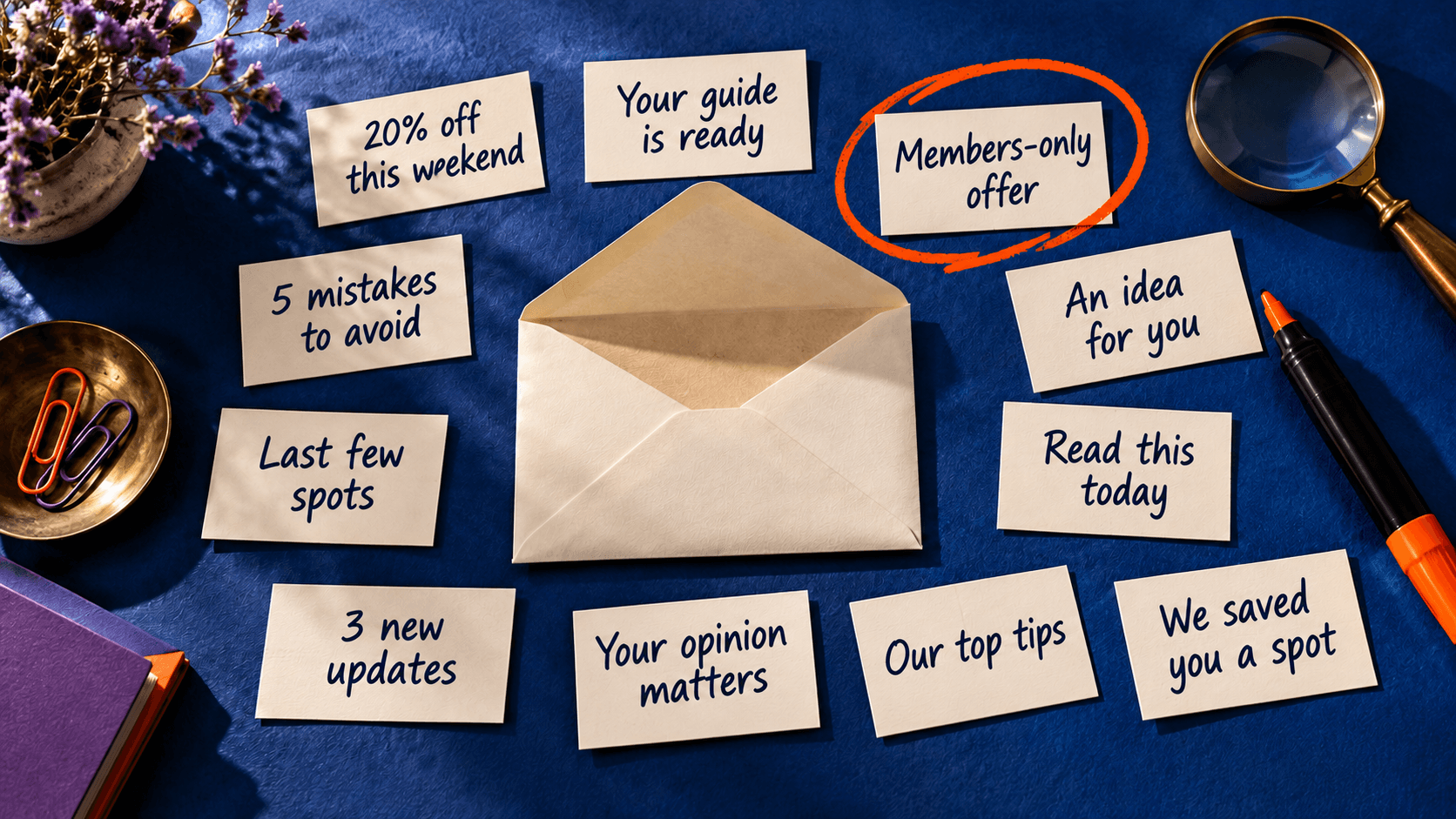
A newsletter subject line is the first contact between your email and its recipient. In an often crowded inbox, a few words can make the difference between a message that is read and one that is ignored.
Finding the right wording takes a little method. Your subject line needs to attract attention, present a tangible benefit and stay true to the message itself. If it is too vague, it lacks impact. If it is too salesy or mysterious, it may disappoint subscribers.
What length should you choose? How do you spark curiosity without falling into clickbait? Which tools can help identify the most effective wording? Discover best practices for writing a relevant newsletter subject line and improving the effectiveness of your email campaigns.
Why is a newsletter subject line important?
The subject line, sender name and preheader are the first elements visible in the inbox. Together, they help the recipient quickly assess whether your message is relevant.
A well-designed subject line can help you:
- Stand out among incoming emails.
- Highlight the benefit of your content.
- Generate interest in an offer, update or piece of advice.
- Reinforce consistency between your communication and subscribers’ expectations.
The goal is not only to generate opens. You need to attract readers who are genuinely interested in the content. An enticing subject line that does not deliver can damage trust and the future performance of your campaigns.
How long should a newsletter subject line be?
A length of around 30 to 50 characters is a good starting point. That range is easier to read on mobile, although the number of characters displayed varies between email clients and devices.
Compare these two examples:
- “Discover our tips for improving your email marketing strategy”
- “5 tips for improving your emails”
The second version presents the topic and expected benefit immediately. It is quicker to understand.
To optimise your subject line:
- Put the important words first.
- Remove unnecessary terms.
- Use simple, direct wording.
- Check how it displays on a smartphone.
Conciseness is a means, not an end. If a few extra words are needed to make your proposition clear, prioritise understanding over a strict limit.
12 tips for writing an effective newsletter subject line
1. Highlight a tangible benefit
Your recipient should understand what reading the email can bring them. A clearly expressed benefit provides a reason to pay attention to your message.
Examples:
- “Reduce your expenses with these tips”
- “Save time with these 5 tools”
- “Improve your email campaigns in 3 steps”
Avoid generic labels such as “Our monthly newsletter”, which do not explain what the reader will discover.
2. Spark curiosity without misleading the reader
An intriguing question or surprising piece of information can encourage people to open a message.
Examples:
- “Is this mistake hurting your newsletters?”
- “The detail you forget in your emails”
- “Why don’t your subscribers click?”
Mystery should remain measured. If the subject line promises a revelation, the content must genuinely provide an answer. Exaggerated wording can disappoint readers and weaken your credibility.
3. Use numbers to structure the promise
Numbers make content more concrete and indicate what the recipient will discover.
Examples:
- “7 mistakes to avoid in your newsletters”
- “3 new things to discover this week”
- “10 ideas to grow your business”
Choose a number that reflects the actual email content. That precision helps build trust with readers.
4. Personalise the message
Personalisation can draw on the recipient’s first name, preferences, previous purchases or interests.
Examples:
- “Mathieu, discover our new selection”
- “New arrivals tailored to your preferences”
- “You liked this guide? Here is the next one”
Adding a first name is not essential. A recommendation adapted to the reader’s needs can be more relevant than a simple name-based greeting.
Check that the data you use is reliable and that personalisation variables work correctly before sending.
5. Create justified urgency
For a limited promotion or registration with an approaching deadline, urgency can encourage a quick decision.
Examples:
- “Last day to take advantage of our offer”
- “Registration closes tonight”
- “Only 48 hours left”
Reserve these wordings for real deadlines. Artificial urgency repeated in every campaign can tire your audience.
6. Ask a relevant question
A question works especially well when it reflects a concrete problem your subscribers face.
Examples:
- “Does your newsletter make people want to click?”
- “Do you know why your emails go to spam?”
- “Does your website convert enough visitors?”
Avoid questions that are too broad. The more readers recognise themselves in the issue, the more likely the subject line is to hold their attention.
7. Use originality and humour
An offbeat tone can set your communication apart from more conventional messages, as long as it respects your brand identity.
Examples:
- “Your newsletter deserves better than radio silence”
- “Are your emails feeling down?”
- “Less waffle, more results”
Wordplay is particularly suited to approachable brands, specialist media and businesses that want a friendly relationship with subscribers. For a sensitive topic or highly institutional communication, a more restrained approach is usually preferable.
8. Clearly announce an offer or something new
For a commercial newsletter, state the information that matters most: a discount, launch or subscriber-only benefit.
Examples:
- “20% off our new collection”
- “Discover our latest release”
- “Your welcome offer is waiting”
Specific wording lets recipients assess the message’s value immediately. Avoid mysterious announcements when your goal is to promote a clearly defined offer.
9. Adapt the tone to your audience
A subject line that is relevant for professionals will not necessarily work for consumers.
For a B2B audience, focus on business challenges, productivity gains or measurable results:
- “How to generate more qualified leads”
- “Automate your sales follow-ups”
- “Metrics to track in your reporting”
For a B2C audience, new products, practical advice and offers may be more appropriate:
- “Our essentials for autumn”
- “Your beauty routine in a few steps”
- “Discover our affordable selection”
Segmenting your contact base lets you go further by adapting messages to each group’s interests.
10. Complement the subject line with a relevant preheader
The preheader is the preview text generally shown next to or below the subject line. It clarifies the promise without repeating the same information.
Subject line: “5 mistakes hurting your newsletters”
Preheader: “Discover how to fix them in your next campaigns.”
Another example:
Subject line: “Your welcome offer is waiting”
Preheader: “Sign up to receive your discount code.”
Write this text carefully so your email client does not automatically display technical copy or an irrelevant part of your content.
11. Use emojis in moderation
Emojis can reinforce a subject line’s meaning or add visual interest, but their effectiveness depends on context and your subscribers’ habits.
If you decide to use them:
- Limit yourself to genuinely useful symbols.
- Check their display on different devices.
- Respect your brand tone.
- Compare results with subject lines without emojis.
Professional, understated communication can do perfectly well without them.
12. Test several versions
A/B testing compares two subject lines with comparable groups of recipients. It helps determine whether a question, a concrete promise or shorter wording produces better results.
You can compare:
- A short subject line with a more detailed one.
- A question with a statement.
- A personalised message with a generic one.
- An informative wording with a sales-led approach.
To understand the results, ideally change only one element at a time. Also ensure that your contact volume is sufficient to draw reliable conclusions.
What mistakes should you avoid?
Some wording can make your message harder to read or create an unprofessional impression.
Subject lines that are too vague
“Some information” or “Our news” gives no indication of the content. Instead, specify the topic or benefit, for example: “4 tips for improving your SEO”.
Exaggerated promises
A subject line must announce what the recipient will actually find in the email. An offer presented as exceptional should provide a concrete advantage.
All caps and excessive punctuation
Subject lines written entirely in capitals and strings of exclamation marks can seem aggressive. Natural wording is generally more pleasant to read.
Repeating the same phrases
Reusing the same expressions in every campaign makes your communication predictable. Vary the angle depending on the content: advice, news, an offer or feedback.
A gap between subject line and content
An attractive subject line is not enough if the message does not meet the expectations it creates. Consistency between promise and content helps preserve subscribers’ trust.
How do you measure subject line performance?
Campaign analysis helps you identify wording that best suits your audience. Several metrics are useful, as long as you interpret them together.
Open rate
It measures the proportion of emails counted as opened by your platform. It remains useful for comparing some campaigns, but privacy mechanisms and automatic image loading can distort it.
It is therefore not a perfect measure of the interest created by a subject line.
Click rate
It indicates the proportion of recipients who clicked a link, according to your tool’s calculation method. It evaluates the interest generated by the content after the open.
A satisfactory open rate with few clicks can point to a content, call-to-action or promise-consistency issue.
Conversion rate
This metric measures the proportion of recipients who completed the expected action: purchase, sign-up, download or quote request.
For a commercial newsletter, it shows whether the campaign delivers concrete results beyond a simple view.
Unsubscribes and spam reports
An unusual increase may reveal poor targeting, excessive sales pressure or disappointing promises. These metrics complete performance analysis and help preserve the quality of your contact base.
What tools can help optimise your subject lines?
Email marketing platforms such as Brevo, Mailchimp and Sarbacane offer campaign-tracking features. Depending on the plan, they let you analyse results and run A/B tests.
A simple spreadsheet can also help you keep a history including send date, targeted segment, subject line, preheader, clicks and conversions.
AI tools can also generate several variations from one topic. Ask them, for example, for shorter, more informative or more original versions.
Treat these suggestions as working ideas: check their accuracy, fit with your brand and consistency with the content you send.
Newsletter subject line examples by objective
| Objective | Example |
|---|---|
| Share advice | “5 tips to improve your results” |
| Promote an offer | “Get 20% off until Sunday” |
| Announce something new | “Discover our latest release” |
| Generate clicks | “The practical guide is available” |
| Build customer loyalty | “Our tips for making the most of your purchase” |
| Promote an event | “Register for our next event” |
| Generate B2B leads | “How to get more qualified prospects” |
| Reactivate subscribers | “Still interested in our advice?” |
| Share news | “What is changing in our sector” |
| Grow sales | “Our selection to discover this week” |
Adapt these examples to your sector, editorial tone and recipients’ expectations. No single model guarantees strong performance on its own.
FAQ: writing a newsletter subject line
How many characters should I use?
Aim for around 30 to 50 characters as a starting point, while prioritising clarity. Check the mobile rendering because displayed length varies by email client.
How can I improve my open rate?
Work on the relevance of your subject line, sender name and preheader. Test different wordings and segment your audience when useful. Interpret open rate cautiously, as some technologies can distort it.
Should I personalise the subject line with a first name?
Not necessarily. Personalisation can make a message more relevant, but its effectiveness depends on your audience. Compare results and check that the data you use is reliable.
Can I use emojis?
Yes, if they fit your brand identity. They do not automatically improve performance: a comparative test will help you evaluate their value.
What is the best time to send a newsletter?
It depends on your subscribers’ habits and your sector. Test different days and times, then compare results while considering send volume and conversions.
How do I run an A/B test?
Compare two subject lines with similar groups while changing only one element. Use a sufficiently large sample and, if your platform allows it, define a clear rule for determining the winning version.
Conclusion
Writing a successful newsletter subject line rests on a simple principle: give people a clear, credible reason to open your email. A concrete benefit, wording adapted to the audience and a well-written preheader provide a solid foundation.
Numbers, personalisation, humour and urgency can complement this approach when they match the content. Testing then lets you refine your choices based on observed results.
Finally, do not limit yourself to open rate. Clicks, conversions and subscriber loyalty will help you assess your campaigns’ real contribution to your marketing goals.